AI Vessel Screening Now Flags Sanctioned Tankers Before OFAC Does, but Hormuz Exposed the Limits
For most of the sanctions era, vessel screening worked backwards. A tanker moved sanctioned crude, an investigation followed, a designation eventually landed on an OFAC or EU list, and compliance teams updated their databases. The vessel by then had usually changed name, flag, MMSI and registered owner. The list described a ship that no longer existed in any operational sense.
Behavioural screening inverted that sequence. Instead of matching a hull against a list of designated names, the newer platforms score how a vessel acts: AIS gaps measured against expected satellite coverage rather than treated as raw outages, kinematically impossible position jumps that betray spoofing, loitering in known transfer zones, rendezvous patterns with other high-risk tonnage, flag histories that hop between registries with thin enforcement capacity. Windward, the largest of the vendors in this space, claims it flagged more than 99% of vessels sanctioned by the EU, UK and US during 2025 before those designations were published. Treat vendor self-scoring with the scepticism it deserves. The underlying shift is real regardless of whether the number survives independent audit.
What gave behavioural screening its teeth was not detection. It was insurance. Protection and indemnity cover became the sharpest instrument in the sanctions toolkit, because an insurer that binds cover on a vessel subsequently designated does not merely hold a bad risk. It becomes a party to the enforcement action. That converted a probabilistic risk score into a commercial decision with immediate consequences, and it sorted the world tanker fleet into two pools: tonnage that can obtain Western cover and operate on conventional lanes, and tonnage that cannot and therefore trades only where cover is unnecessary or supplied by Russian-linked and newly created clubs.
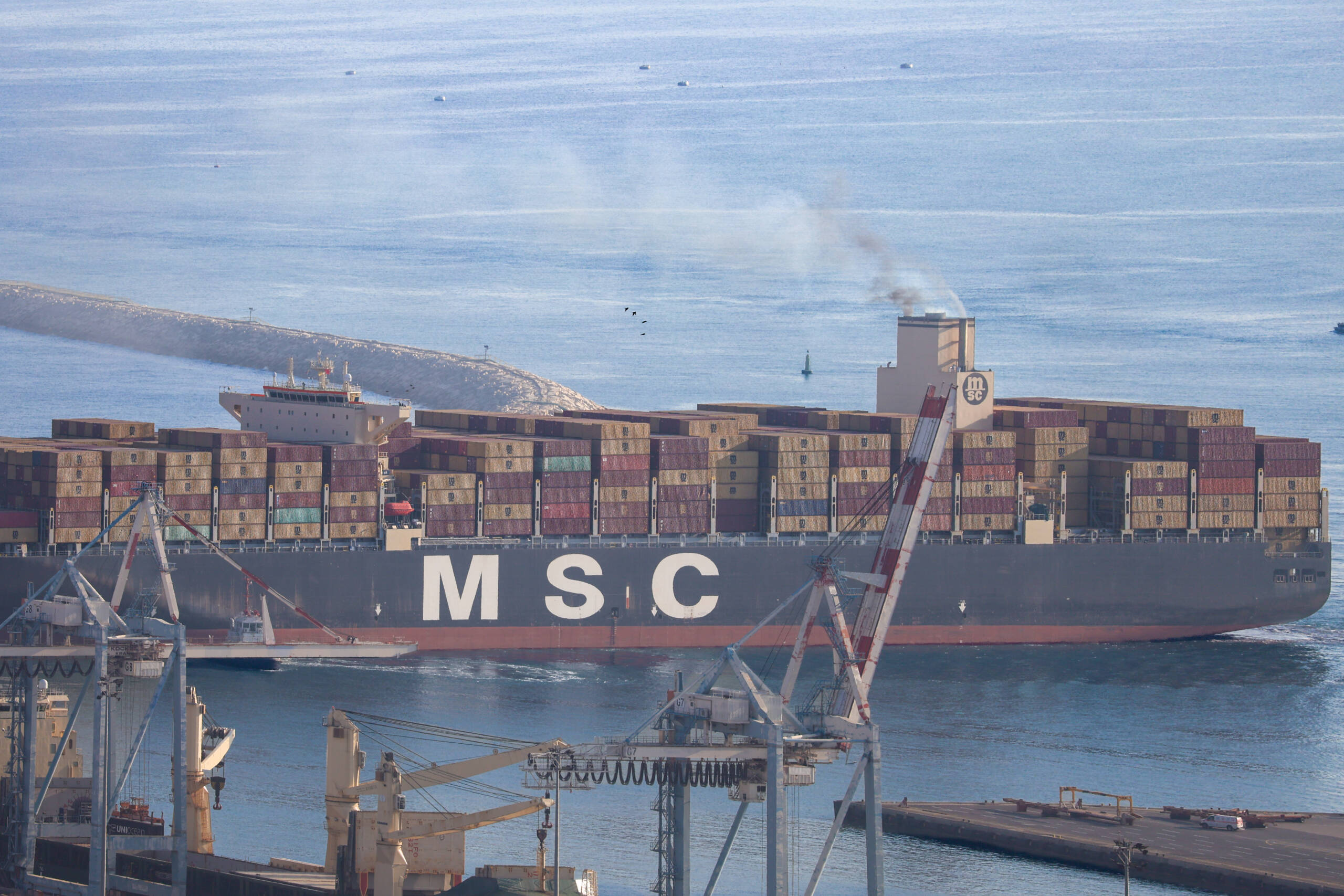
The size of that second pool is disputed. Estimates range from several hundred tankers to nearly two thousand depending on whether the count includes vessels that have carried sanctioned cargo once, vessels structurally configured for it, or vessels merely insured outside Western clubs. The variance in the published figures is itself informative. Nobody counting has full visibility, which is the point of the fleet.
Hormuz Broke the Signal
Then February 28 happened, and the analytical foundation moved.
Before the conflict, roughly 3,750 AIS-visible transits passed through the Strait in a typical month. March recorded 450. Traffic edged back after the June 17 memorandum and the lifting of the blockade the following day, briefly clearing twenty crossings per day, before Iran declared the Strait closed again on June 20 and reinstated the PGSA toll and clearance regime. Even counting the partial recovery, June finished around 83% below the pre-conflict baseline.
The vessels still moving did not all disappear. A growing share simply stopped broadcasting. Windward’s second-quarter figures put 2,157 unique cargo ships and tankers above 10,000 deadweight tonnes into at least one dark event lasting more than three days, against 449 in the first quarter. The count of prolonged events rose from 451 to 3,137. Russia recorded the heaviest single concentration at close to 4,000 individual events. The Gulf jurisdictions of Saudi Arabia, Oman, Iran and the UAE together accounted for one extended dark event in four, against a first quarter in which Indonesia, China and Romania led and Russia sat fourth.
Here is the problem that creates. A large fraction of those Gulf dark transits are entirely defensible. A merchant vessel entering an active war-risk zone has legitimate reason to reduce its electronic signature, and owners have been switching AIS off with flag state consent as a documented safety measure. Vessels transiting the American-supported southern corridor under escort have done the same. Silencing AIS in a shooting environment is prudent seamanship, not evasion.
But the shadow fleet uses the identical behaviour for the opposite purpose, and both categories now produce the same signature in the same water at the same time.
The Noise Floor Rose
Behavioural risk scoring depends on anomaly. It works because deceptive shipping practices are statistically unusual against a background of vessels that broadcast continuously and route predictably. Strip out that background and the discriminating power collapses. When one in four extended dark events globally occurs in the Gulf, and when a substantial share of those have documented flag state authorisation behind them, going dark near Hormuz stops being an anomaly. It becomes the regional norm.
The vendors’ answer is multi-sensor fusion: synthetic aperture radar and electro-optical imagery to place a hull at a location regardless of what it broadcasts, radio frequency detection to catch emissions from operational systems that keep running when the transponder is off, historical behavioural context to establish whether a particular vessel is going dark in a manner consistent with its own past. Combined, these reconstruct a defensible picture of what happened inside a dark window without depending on the vessel’s own account of itself.
That works. It is also expensive, latency-bound and analyst-intensive, which means it does not scale to every hull transiting a contested strait. The industry has quietly shifted its stated constraint from coverage to speed, on the reasoning that a correct answer delivered after the operational window closes has no value. Tasking a satellite over a specific dark window is a resource decision, and resource decisions require prioritisation, and prioritisation requires exactly the risk signal that the Hormuz environment has degraded.
The consequence is a widening gap between two classes of participant. Institutions with fused sensor access can still see through most dark windows. Institutions relying on AIS and list screening, which includes a substantial part of the trade finance and cargo insurance market, have lost visibility over a growing share of Gulf traffic and in many cases do not know it.
What Follows
The disputes are already arriving. Charter arbitrations now turn on reconstructing what a vessel did during a period when it was, by mutual agreement and for good reason, not reporting its position. Safe port warranties, force majeure claims and deviation allegations all hinge on evidence that the parties deliberately chose not to generate. Legal counsel is buying the same reconstructed pictures that compliance teams buy, for the opposite purpose.
None of this reverses while the conflict persists, and the dark share of Gulf traffic is unlikely to fall back to pre-February levels even if the PGSA regime lapses. Operators who learned that AIS silence is survivable, tolerated by their flags, and occasionally advantageous have limited reason to unlearn it.
The screening systems solved the problem of lists that arrive late. They did not solve the problem of a strait where everyone has a reason to hide.